

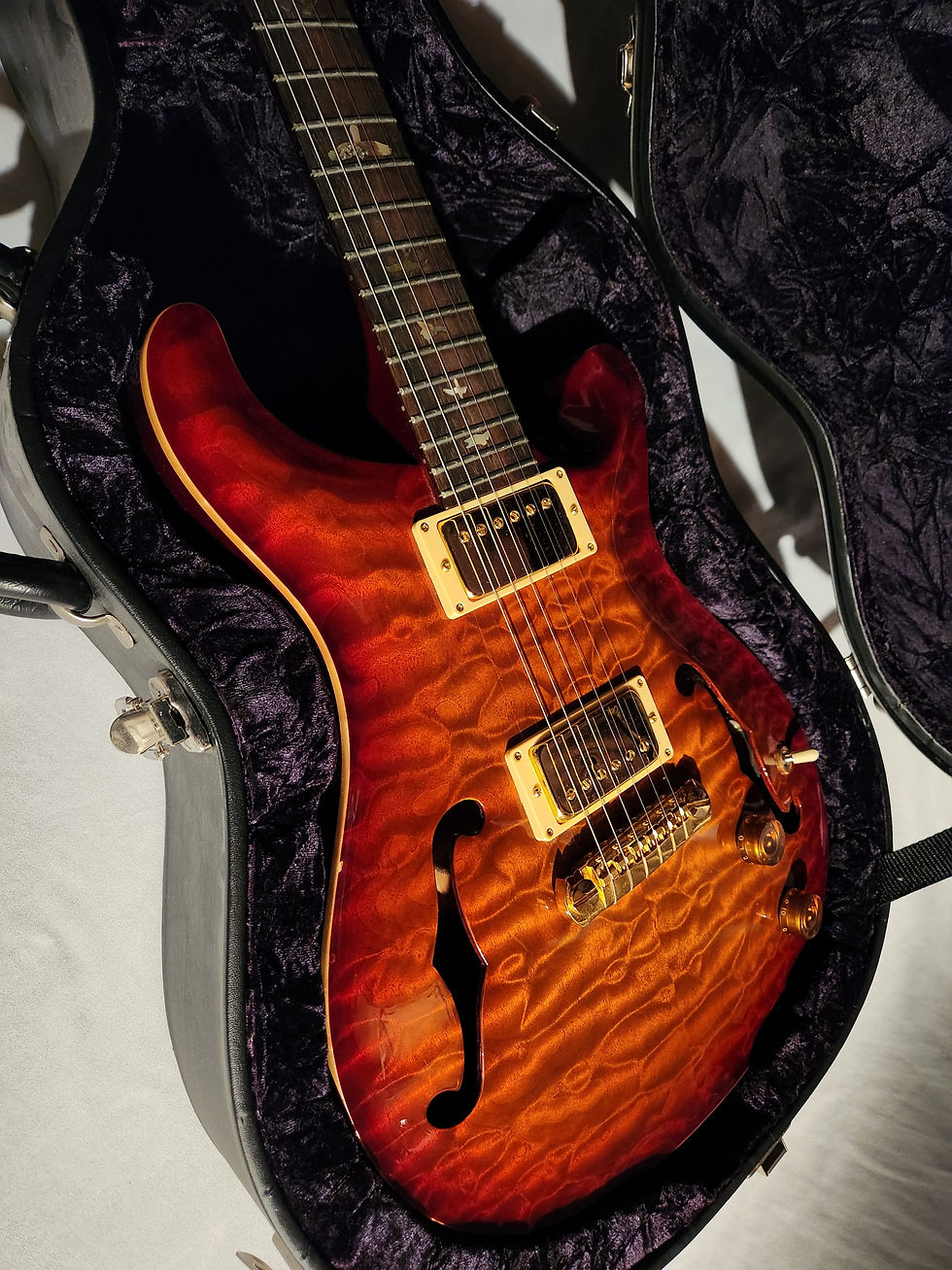
1997 Paul Reed Smith
McCarty Archtop 2
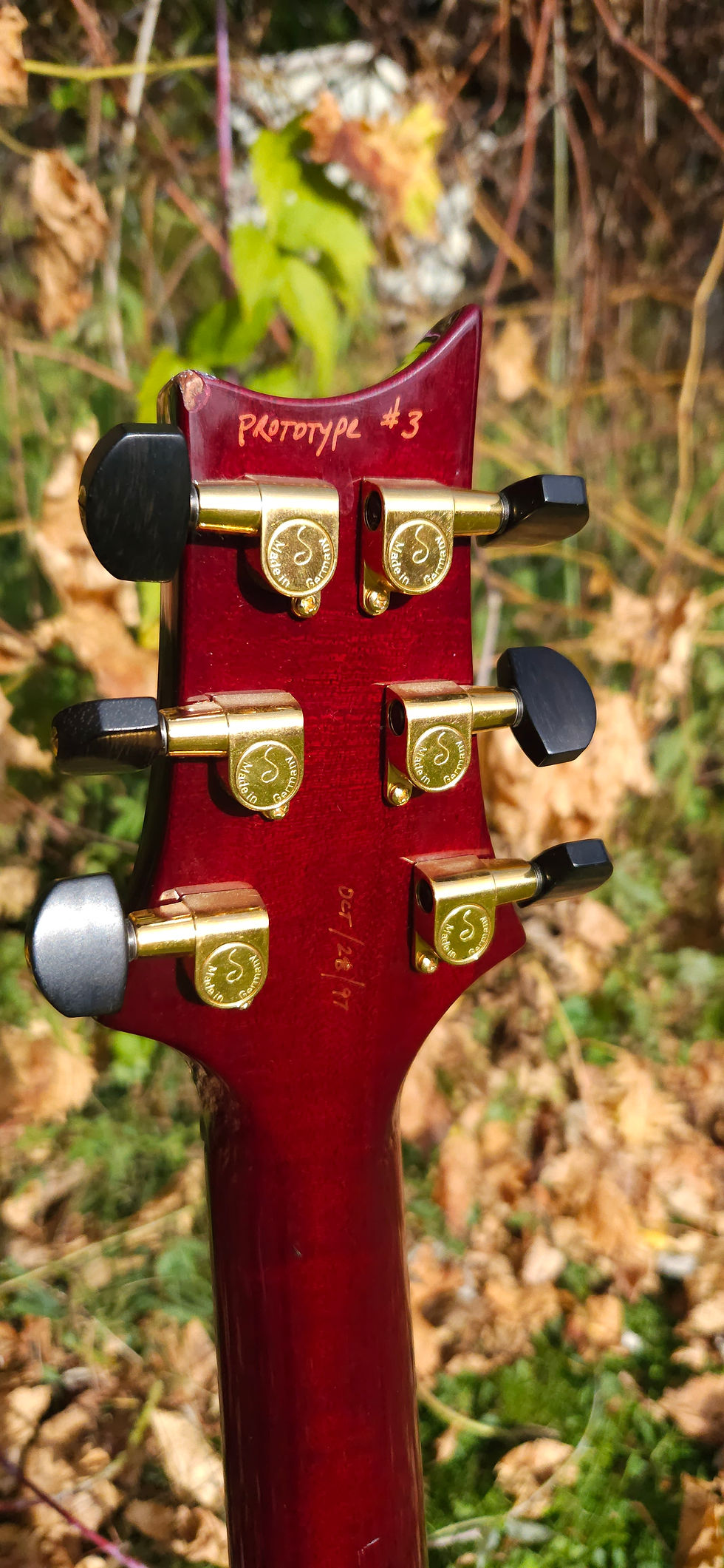
PROTOTYPE #3
_Cherry Sunburst_




Click on "Show More" above to see all 24 pictures in this gallery
Since they were first manufactured in 1998, the PRS Hollowbody & Archtop guitars have stood above the industry for both natural and amplified tone. I bought my first PRS Hollowbody in 2003 and said ever since: “These PRS Hollowbody (and Archtop) guitars cut right through the mix on stage. Every note of your tone carries and doesn't have to be obnoxiously above the mix to be heard." Also: "Through the amplifier, each note of a six string chord rings out with clarity and in perfect balance with each other." I’ve owned more than a dozen since and they never disappoint.
This guitar is a piece of PRS history, built as a prototype for the PRS Archtop model. The finest woods and materials were used to showcase these instruments to the industry. All of the Archtop Prototypes (approximately nine of them) were built under the supervision of Joe Knaggs, while he worked for PRS before launching his own very successful line of high-end instruments at Knaggs Guitars. It is signed by Joe in the neck pocket. The letter in the photo is from Prototype #9, but all of the dynamics are the same. Worth mention, there is a guy in Canada that currently has one of these listed at $18K.
PROTOTYPE definition: A prototype is an early sample, model, or release of a product built to test a concept, validate its design and gather user feedback.
The short path and history of this particular guitar: I am essentially the second owner. I bought it on e-Bay in or around 2010 from a recording studio in North Carolina. The seller told me that sometime after the 1998 NAMM show roll-out, Paul donated this guitar to the studio as a "house instrument" for recordings. When it arrived, I promptly put it in storage, playing it only occasionally over the years. It plays so easily, that it feels like it has 8 gage strings on it from the studio and it might. I don't know for sure. I've played it very infrequently and I've never re-strung it. I like it just the way it is. There is no telling how many professional recordings this guitar appears on from its 10+ years in that studio.
The 1998 NAMM show was the official launch the Archtop (1998-2003) and Hollowbody (1998-present) models. The Archtop guitars are largely the same as the Hollowbody models, but the body is a full inch deeper giving it greater resonance and sustain both acoustically and amplified. The Archtop Bass & Treble pickups were designed specifically for these guitars, and they are perfectly suited for complete control of any feedback that players commonly associate with amplified hollow body instruments. You can play these Archtops straight into the amp for warm, clean tones or dress your tone to any degree that you like with effects. Uncontrolled feedback is never a problem, even when playing aggressively over-driven. I gig these Archtops regularly in rock genre using the Archtop humbuckers and also in solo acoustic format using the (optional) Piezo pickup system. The Piezo equipped guitars are a great option for switching from electric to acoustic tones on the fly in live performance. The piezo can also be blended with the Archtop humbuckers for additional definition. With or without the Piezo, these guitars can truly be dialed in, to excel at anything you're into. Jazz, rock, country, pop, etc. Note: The guitar in this listing is not a Piezo equipped instrument and that is a part of its beauty (see my notes below regarding Piezo vs. non-Piezo guitars). I do have other listings for Archtop Piezo guitars on this website, if you feel that is what you need.
These deep body Archtops are also great for playing unplugged around the house. The natural acoustic projection is a considerable boost in volume over any other solid body or hollow body electric guitar that you might practice with, allowing it to be heard over ambient sounds whether indoors or outdoors on a porch. They are hollow throughout, with only a center post beneath the bridge, which joins the top of the guitar to the back. The center post is there to transfer the resonance of the strings throughout the body while simultaneously controlling feedback. You can see the center post in a close up taken through the f hole of an Archtop II guitar in photo #17 above. The quilted Artist grade top and back wood selected for this build, give this Prototype Archtop II a particularly rich & articulate sound.
This guitar was played by many professional and semi-professional musicians during it's time in the studio, because it is a simply awesome instrument. It did pick up some superficial nicks around the top and back binding, as well as on the headstock tips. The cosmetics are detailed in photo #18 above. These cosmetics were all there when I bought the guitar and I did not hesitate to buy it. It is "playable" by virtue of having been played, but the PRS Tech Center could easily make this highly collectable piece of PRS history brand new again with relatively low cost, in regard to the scope of the tiny random dings that it has. Comes with the original hardshell case, which is extremely clean as well, inside and out. It has never been shoved into the back of a car or lugged into a club. From PRS to the NAMM Show, then to the studio where the guitar was only taken out of its case for sessions, then to my house. Though it may have been played often, it was used by many different players and the frets show no signs of wear what-so-ever, all the way up & down the Brazilian board, past the colorful abalone inlays.
I’m a working (weekend) musician who has bought, owned, gigged and sold over 300 different PRS guitars of all models since 2001. I’ve played a few rather impressive (electric) SE’s that were pleasantly above my expectations for their price point though I've encountered more planks than gems. That said: The SE Hollowbody models do not come even close to the tone and quality of a core Hollowbody, nor to an Archtop (if they made them as SE). Not at any price.
________________________________________________________________
I’ve heard it said in the forums that a non-Piezo Hollowbody is of less value that a Piezo model. The piezo guitars surely cost more, but that doesn’t mean you “need” it. If you know what they are and you know you want one, Piezo is a great option. You should look for a Piezo PRS. I have some Archtop Piezo guitars available here on my site. If you’re not likely to ever use the Piezo (many players that own them don’t), then don’t buy one. Here’s why: First, the piezo units increase the weight of the guitar significantly. The Piezo guitars are still quite light, even with the option on board, but they are meaningfully lighter without it. Second, the piezo bridge frame is slightly thicker and the Piezo saddles are a little higher than either the adjustable or non-adjustable bridge that comes on a non-Piezo guitar. The neck angle is fixed and built right into the guitar. No amount of truss adjustment will change that. The higher contact point on the Piezo bridge for each string, limits how low the guitars action can be set. To get the most out of the piezo, the factory sent them out with 11's or 12's on them. You can use them with 10's or 9's, but the piezo tone gets thinner as you move your string gage down. I'm only trying to be helpful. Please understand that I have both Piezo and non-Piezo PRS guitars. I love them all and play both versions regularly. I’m just saying, make sure you’re looking for the guitar that you want, instead of the guitar that you think you want. The Piezo is an expensive option if you’re not going to use it and having it on board does impact the playability in some small measure.
A Word About Core PRS Guitars:
PRS has always made great guitars and they still do today. From 1985 until 2001, all PRS guitars were core PRS guitars. The 2001 Santana III was their first model created as a second-tier instrument. Basically, a financial decision to explore the lower price point market with an eye on producing off-shore. It is probably not a coincidence that the high-end Archtop Models were discontinued at a time when they needed more capacity to build second and third tier instruments. Their USA and off-shore guitars of today are essentially made by two different companies, creating two different families of instruments. There are the cores in one family and everything else in the other (not to mention the Wood Library pieces or of course Private Stock, both in a league of their own). In the Forums I see a lot of SE’s with problems right off the rack or that have been so modified by their owner, they could have just bought a core PRS to begin with. PRS still regards the new CE-24 as a core model, but they are less than one-half the guitar that core CE’s were from 1995 to 2016 and one-quarter the guitar that the pre-factory alder body CE-24’s are. Those second (S2) and third tier (SE) guitars lose whatever value they ever had rather quickly. The new core guitars are fabulous instruments, but sticker north of five or six grand and will be worth far less in 4-5 years. If you’re casually looking here out of curiosity, while thinking more seriously about buying your sixth SE in a different color, your third S2 or a new CE-24, give some thought and consideration to selling some of what you’ve already got, to buy a Core PRS instead. Core PRS guitars hold their value and every Hollowbody core I’ve owned or played is LEVELS ABOVE every SE Hollowbody that I’ve ever encountered. Just the opinion of a PRS enthusiast that has bought, sold, owned and gigged over 300 PRS guitars across the last 25 years.
__________________________________________________
Please be sure to take a moment and click here to look at my ABOUT page. or access it from the top menu bar. I encourage even the smallest of questions so always feel free to e-mail me any time.
This guitar is also listed on sites with a starting price of $350 more than I'm asking here on my site, just to put a dent in the seller fees they would charge me for a transaction there.
Why pay more than you have to? Check my feedback and buy it here. It may be gone soon. Send me an e-mail and we'll talk.
If you've come to this page directly through an organic Google search,
click this link to see a list of all the guitars I currently have for sale before leaving this page.
$8,400 includes shipping anywhere in the lower 48.
I recently heard someone a lot smarter than I am say:
"Life is short..... Buy the guitar"
Here are some things to think about as you look through the gallery below.
-
This is a prototype Archtop guitar that was built for the 1998 NAMM Show to introduce the model.
-
Archtops were only in production from 1998-2003 before being considered too costly to produce.
-
Only available through Private Stock now
-
A Rare, Deep Body, Archtop II with a Brazilian fretboard and an artist grade Quilted Maple top & back
-
Warm and clear with cutting bite when you need it
-
Naturally aged into Vintage Status at 29 years old
-
Very light weight, at just 6.1 lbs.
-
Have a look at the pictures and then READ ON for the story of this 2nd owner guitar!
Click on any picture to enlarge and/or scroll through the gallery
You read that correctly. This is a 1997 PRS Archtop 2
Scroll down to see 24 High-Def pictures