

Invest in a Guitar That Will Hold its Value for as Long as You Own it
1992 Paul Reed Smith
Custom 24
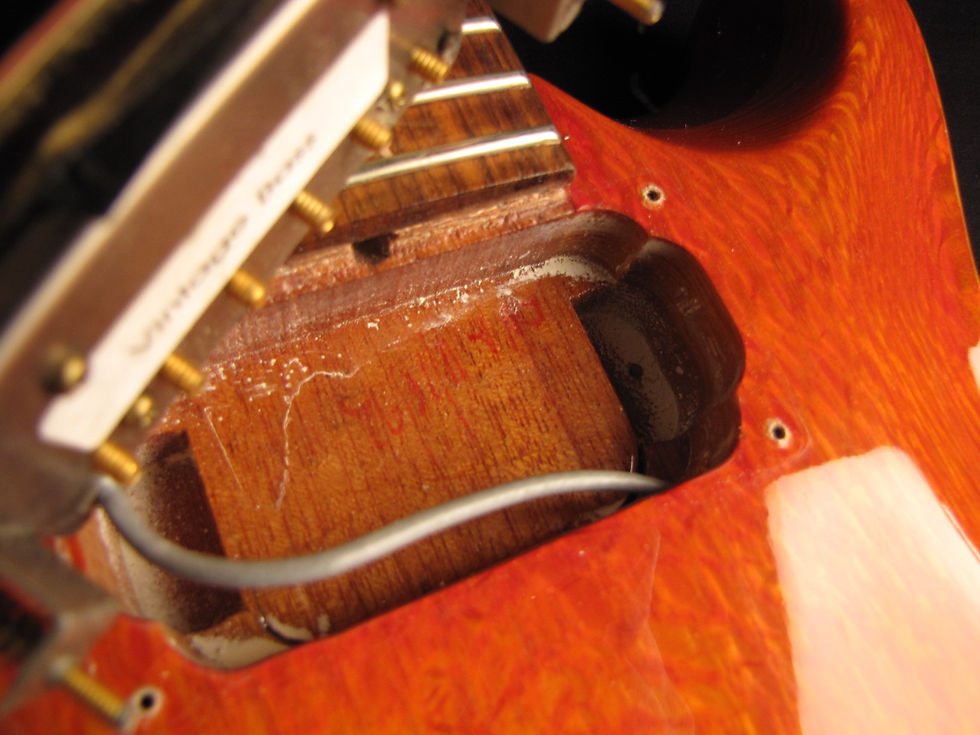
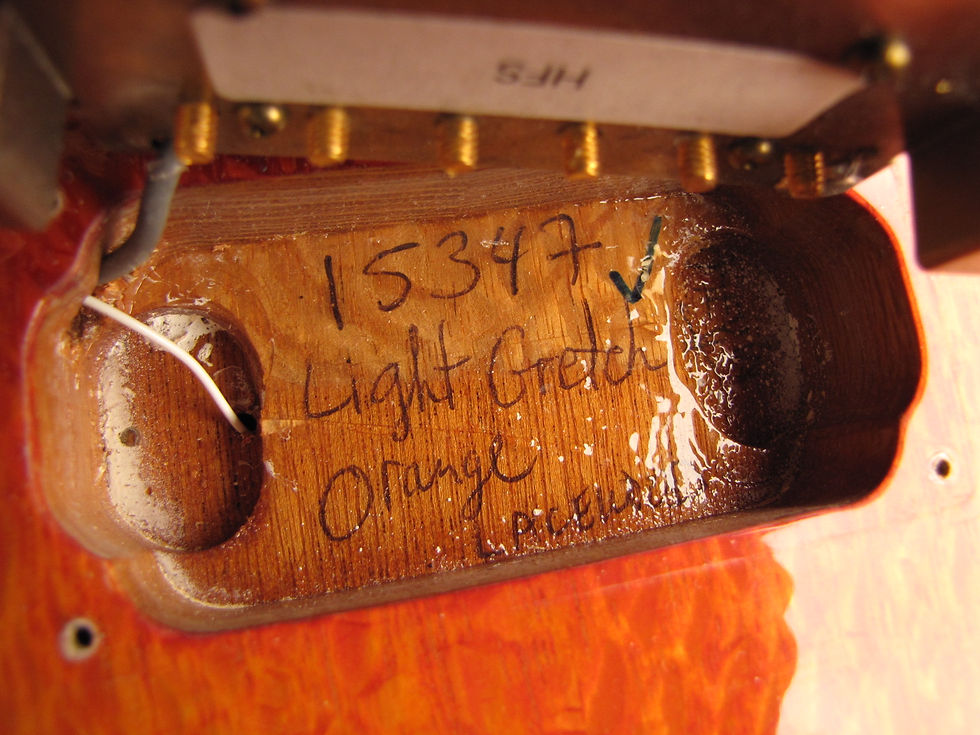
_Light Gretch Orange_
As marked in the cavity
African Lacewood Exotic Wood Top





Click on "Show More" above to see the rest of the pictures in this gallery
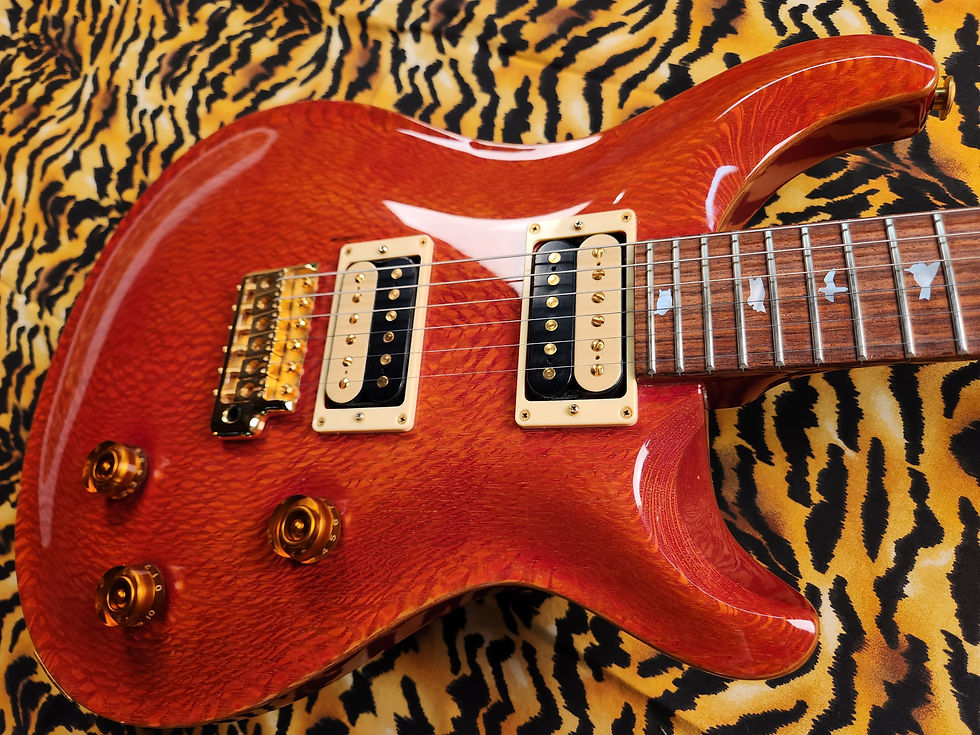
In 1991 and even more so in 1992, the PRS shop was experimenting with series of builds featuring exotic wood tops. Cedar, Redwood, African Lacewood and Zebrawood among them. I've owned several of them along the way. The symmetrical grain pattern of this African Lacewood top is unique and exquisite, while the Light Gretch Orange finish (as marked in the cavity) is the perfect color to bring it out. The feather-like grain reflects light around the edges as you turn it in the light. Enlarge picture #5 to see how the Lacewood grain in the horns seems to "flow" toward the neck pocket as well. The guitar came with gold colored metal surrounds. I put the bone-colored surrounds on it. Enlarge picture #6 for a (limited) view of the metal surround. The rosewood board (featured in picture #6 also) is nicely grained, which provides a perfect contrast with the top.
I've taken this guitar out to gigs on many special occasions over the years. It's a stunning beauty on stage with a wide/thin neck carve that is super comfortable and fast. It's a pleasure to play and the mechanical five-way rotary switch has pro tone in all five positions. The cosmetic condition is excellent. I rate it at 9.7 on a scale of 1-10. There is a small streak of dark wood grain beneath the finish just above the bridge, which you can see in some of the pictures. The guitar came from the factory this way. I believe it was meant to be one of the Limited Edition guitars from that era, but was rated down to a 10 Top instead, due to this woodgrain anomaly. The headstock tips are perfect. There is one small spot in the clear coat on the back of the neck as seen in picture #15. The back of the guitar has no dents, dings or buckle rash at all. The frets have no meaningful wear at all, even in the first three frets. It is lightly played, which only makes it "playable". You could put it in a glass case, but I would recommend playing it every chance you get instead.
When this listing comes down, the guitar will likely land with a collector and you'll never see anything like it again. If you're giving this guitar any serious thought at all, you might consider pulling the trigger before someone else does. This is a rare and exquisite pre-factory PRS, which will build value for as long as you own it.
These vintage pre-factory PRS guitars are an investment. You'll ALWAYS have the option to re-sell it for as much or more than you paid.
This guitar was hand made by a small group of craftsmen who were on a mission to build a world class guitar company. The outstanding quality of the pre-factory PRS guitars produced during the first ten years at the Virginia Avenue shop, is the foundation on which the PRS factory was eventually built and from which their global brand was launched.
A word on Pre-Factory PRS Guitars and Factory built PRS Guitars
The new core guitars built in the factory are fabulous instruments. Rock solid and perfect. Perhaps too perfect. I look at it as the result of feeding a blank of wood into a machine at the front end of a production line and taking a very fine guitar out of a different machine at the end of that line. Over the years, every single step of the build that can be automated, has been automated. The virtual absence of a craftsman’s hands throughout the build process somehow makes them feel like identical coins stamped out of a machine. Very, very fine coins, Yes! Yet still, a sterile product of hyper automation compared to the guitars from the Virginia Ave. shop made by the original team of craftsmen before 1995.
Before the factory opened in 1995 the PRS team built approximately 30,000 guitars in a warehouse shop over the ten years prior (~20K Customs and ~10K CE-24’s). The Second Tier (S2), Third Teir (SE) instruments were not even remotely on their radar. The fork in the road that started PRS down a path to flooding the market with cheaper models started seven years after the factory opened with the introduction of the Santana III. The S2 and SE lines that followed, have produced over 650,000 of these Second/Third Teir guitars, in addition to the half-million cores built since 1985. The USA PRS factory now produces over 25,000 core guitars each year, every year. The guitar in this listing is from the first 14,000 core guitars that PRS ever made.
Here is an overview of the permanent design changes that took place for the Custom 24 and CE-24 model when mass production began at the factory in 1995.
-
The neck heel was extended, impeding access to the upper frets
-
The solid block Mil-Com tremolo bridge was redesigned to a five-piece assembled unit
-
The mechanical rotary (3 unique versions in the first 10 years) was replaced by a switch which routes the pickup signal through a Printed Circuit card
-
The small headstock decal that identifies the guitar as a vintage original was abandon for a larger, polished gold decal
-
The individual character of each instrument, was homogenized away in favor of sterile, mass production protocols
Why These Things Matter:
I’ve bought, sold, owned and gigged over 300 hundred PRS guitars throughout the past 25 years. The original, Pre-Factory, mechanical blue wafer rotary switch provided direct connection between the vintage pickups and the output jack. All guitars that came after 1995 have newly designed rotaries, which utilize a printed circuit board to channel the pickup’s signals. Where there were three versions of the original rotary which provided unique pickup coil combinations, all rotaries after 1995 are coil-configured exactly the same. The circuitry of the printed circuit rotaries also suppress the raw signal from the pickups subtly, in a way that the original mechanical switches do not.
I’ll never understand the neck heel change. I believe they sacrificed that feature to accommodate automation during the build process. In 2011 PRS created a Guitar Center “Throwback 1985” run of Custom 24’s. The model was not true to spec in several key aspects. The neck heel was shaved down to a passable version of the original short heel contour, so why can’t they put a short heel on all of them?
The one-piece Mil-Com bridge is said to be more resonant. I don’t know if anyone could tell the difference, but it is unique to the pre-factory guitars, it does weigh more than the assembled bridges and was probably re-designed just to cut costs.
The headstock decal change is sort-of a good thing. Like the short neck heel, the small signature decal is an immediately recognizable indication that a PRS guitar was made between 1985 and 1994 in the Virginia Ave shop, with a considerably higher level of hands-on, personal craftsmanship in the build.
A Word About Vintage Instruments:
You can tell when you have a true vintage instrument in your hands. The resonance of the wood which has aged naturally for decades simply can NOT be duplicated in a new instrument. The Retro, Relic, Custom Shop, Re-Issue, Private Stock, Murphy Lab, Master Built, Throw-Back, etc. guitars can all be built to their original spec, but will never replicate natural aging of the wood through the passage of time. This is a vintage PRS guitar in excellent condition, which is ready for you to honestly, respectfully and authentically “relic” as you make it your own. All at less than the cost of a new core Custom that will sell for half what you paid for it, four years from now. If you’re casually looking here out of curiosity, while thinking more seriously about buying your sixth SE in a different color, your third S2 or a new CE-24, give some thought and consideration to selling some of what you’ve already got to buy a vintage Core PRS instead. Pre-Factory PRS guitars are still affordable and will always increase in value, for as long as you own, play and hold them.
____________________________________________
Please be sure to take a moment and click here to look at my ABOUT page or access it from the top menu bar. I encourage even the smallest of questions so always feel free to e-mail me any time. Over 140 of my online feedback ratings are from PRS guitar sales.
This guitar is also listed on sites with a starting price of $350 more than I'm asking here on my site, just to put a dent in the seller fees they would charge me for a transaction there.
Why pay more than you have to? Check my feedback and buy it here. It may be gone soon. Send me an e-mail and we'll talk.
If you've come to this page directly through an organic Google search, click this link to see a list of all the guitars I currently have for sale before leaving this page.
$4350.00 Includes shipping to the lower 48
I recently heard someone a lot smarter than I am say:
"Life is short..... Buy the guitar".
Here are some things to think about as you look through the pictures. Read MUCH more at the bottom of the listing page.
-
A rare & collectable Exotic Wood pre-factory guitar with an African Lacewood 10 Top.
-
Gold Pole / White label HFS & Vintage Bass pick-ups
-
All Gold Hardware
-
Small neck heel for best access to the upper frets, available only on these pre-factory (1985-1994) guitars
-
A comfortable Wide/Thin neck carve
-
One-piece Mil-Com bridge for maximum resonance
-
A vintage PRS, with tone wood naturally aged since it was built 34 years ago
-
Built in an age when ALL PRS guitars were Core PRS guitars
Be sure to enlarge and scroll the pictures to truly appreciate this Lacewood Top
Scroll Down for 24 Hi-Def Pictures